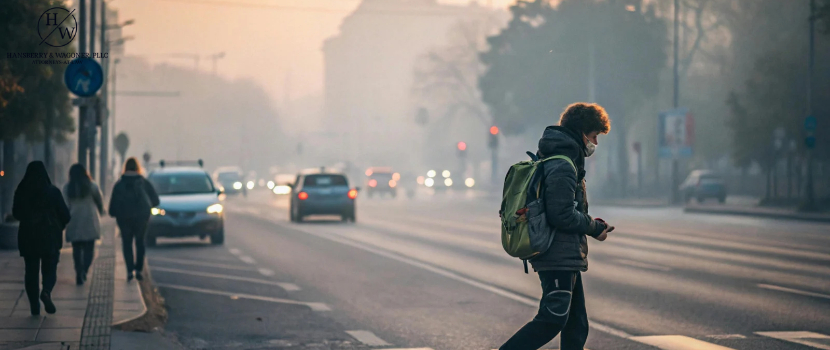

You’ve probably already gone back over it more than once. Where you were standing, whether the light had changed, whether the driver even had time to see you. Maybe the officer’s report already leans one way, or an adjuster called and asked a few too many questions about the crosswalk.
West Virginia pedestrian right-of-way laws do favor people on foot at most crosswalks, marked and unmarked, but that protection isn’t absolute, and neither is fault. Whether you were crossing Walnut Street in downtown Morgantown or cutting through a Bridgeport parking lot, exactly where you were standing when the car approached shapes what happens next.
That’s the kind of detail Hansberry & Wagoner’s pedestrian accident lawyers have spent years sorting out for West Virginia families hit while walking. If a driver struck you and you’re not sure where you stand, keep reading.
Do Pedestrians Always Have the Right-of-Way in West Virginia?
Not automatically. Under West Virginia law, a driver must yield to a pedestrian crossing within a marked crosswalk or an unmarked crosswalk at an intersection, but only when there’s no working traffic-control signal telling each side what to do. Once a signal is functioning, whoever has the green light or the walk symbol controls the intersection, and that can be either party depending on the moment.
The right-of-way isn’t a license to step off the curb without looking, either. State law is specific that a pedestrian may not suddenly leave a place of safety and walk into the path of a car too close to stop, even inside a crosswalk. The law protects people already crossing, not people who dart out.
If a driver hit you and the story already sounds like it’s tilting toward blaming you, talking to a West Virginia pedestrian right-of-way attorney before you sign anything is worth it. It only takes about twenty minutes, and it can keep you from signing away more than you meant to.
What West Virginia Law Says About Crosswalks
The rule pedestrians rely on most often lives in West Virginia Code § 17C-10-2, and it draws a sharper line than most people expect.
Marked Crosswalks
At a marked crosswalk — painted lines on the pavement — a driver has to slow down or stop for anyone crossing on their half of the road, or close enough to the center line to be in danger. It doesn’t matter whether the crosswalk sits mid-block or at a corner. If the lines are there, the obligation is there.
Unmarked Crosswalks at Intersections
Every intersection in West Virginia carries a legal crosswalk even without paint, as long as sidewalks connect on both sides. Drivers owe pedestrians the same yield at these unmarked crossings as they do at painted ones. This surprises plenty of drivers, who assume no lines means no rules.
What Happens When There’s No Crosswalk Nearby
Cross mid-block, away from any intersection, and the obligation flips. Crossing outside a marked or unmarked crosswalk puts the burden on the pedestrian to yield to vehicles already on the roadway.
That doesn’t mean a driver can plow through someone jaywalking on purpose. Drivers still owe a general duty of due care. But if you’re crossing outside a crosswalk and a car doesn’t have time to react, the law may favor the driver.
This matters in a college town. Students walking between apartments and campus, cutting across High Street or University Avenue between marked intersections, are a common sight in Morgantown, and it’s exactly the kind of crossing that gets picked apart after a crash.
Common Ways Drivers Violate a Pedestrian’s Right-of-Way
Most pedestrian crashes trace back to a handful of driver mistakes, and NHTSA’s pedestrian safety data points to the same patterns nationwide.
- Turning right or left into a crosswalk without checking for someone already crossing
- Passing a vehicle stopped for a pedestrian, which West Virginia law prohibits outright
- Rolling through a stop line or crosswalk instead of coming to a full stop at a red light
- Distracted driving through school zones and downtown corridors, where drivers assume a pedestrian will see them first
Hansberry & Wagoner has spent years untangling exactly these percentage fights and knows how to lock down the record before an adjuster finishes writing the narrative.
What If You’re Partly to Blame for the Accident?
Being partly at fault doesn’t erase your case. It shrinks it. West Virginia’s modified comparative fault law has a jury assign a percentage of blame to everyone involved, including the pedestrian. If you’re found 50% or less responsible, your damages get reduced by that percentage, not wiped out. At 51% or more, you recover nothing.
Why Morgantown and Bridgeport See So Many Pedestrian Accidents
Pedestrian crashes in West Virginia aren’t spread evenly across the map or the clock. State highway safety data has tracked pedestrian fatalities clustering in a small number of counties. This same data also shows that Thursday evenings between 9 and 10 p.m. as an unusually high-risk stretch for people on foot. Morgantown adds its own layer, a dense mix of students, bar traffic, and unlit side streets around campus, while Bridgeport’s commercial strips along Route 50 push fast-moving traffic close to sidewalks with far less lighting.
A pedestrian right-of-way attorney at Hansberry & Wagoner can pull the crash report and camera footage before that story sets, and the first conversation costs you nothing.
Frequently Asked Questions About Pedestrian Right-of-Way Laws
Can I still recover damages if I wasn’t in a crosswalk?
Yes, you may still have a case. State law just means a jury weighs your position against the driver’s actions — how far outside the crosswalk you were, versus how fast, distracted, or inattentive the driver was. You won’t get shut out unless your share of the blame crosses the 50% mark.
How long do I have to file a pedestrian accident claim in West Virginia?
You’ll generally have two years from the date of the crash to file a personal injury lawsuit, under the state’s general statute of limitations for injury claims. That said, the two-year clock can start later in some situations — for example, if you didn’t realize you were hurt right away, or if the injured person was under 18 at the time. Ask a lawyer to check your specific dates rather than assuming the clock started on the day of the crash.
What if the driver says I came out of nowhere?
That’s a common line from drivers and adjusters, and it doesn’t automatically mean you’re at fault. Where you were standing, whether a crosswalk was nearby, and how fast the driver was going all factor into who gets assigned blame. A police report, nearby camera footage, or a witness on the sidewalk can settle the question fast.
Does it matter if I was on a sidewalk or road shoulder when I was hit?
Sidewalks and shoulders aren’t roadways, so a car has no business being on either one. If a driver drifts onto a sidewalk or shoulder and hits you, that’s a more straightforward negligence claim than a right-of-way dispute. Photos of where the vehicle ended up matter a lot if this happens to you.
Is jaywalking actually illegal in West Virginia?
Not exactly, though crossing mid-block without yielding to traffic can get you a citation in some West Virginia municipalities. It’s treated as a minor infraction in most cases, not a felony, and it’s separate from who pays your medical bills after a crash. A jaywalking ticket doesn’t automatically decide your civil case.
Hansberry & Wagoner, PLLC: Your West Virginia Pedestrian Accident Law Firm
Getting hit while walking leaves you sorting through police reports, insurance calls, and a story that may already be leaning against you, and that’s a lot to carry while you’re still healing. The injury attorneys at Hansberry & Wagoner have spent years pulling apart exactly these percentage fights, matching crash reports against camera footage and witness statements before an adjuster gets to write the narrative first.
Whether you were crossing on High Street in Morgantown or along Route 50 near Bridgeport, where you stood matters, and it’s worth having someone dig into the details before you accept an early settlement offer. Contact our firm today, and let’s look at what actually happened.